
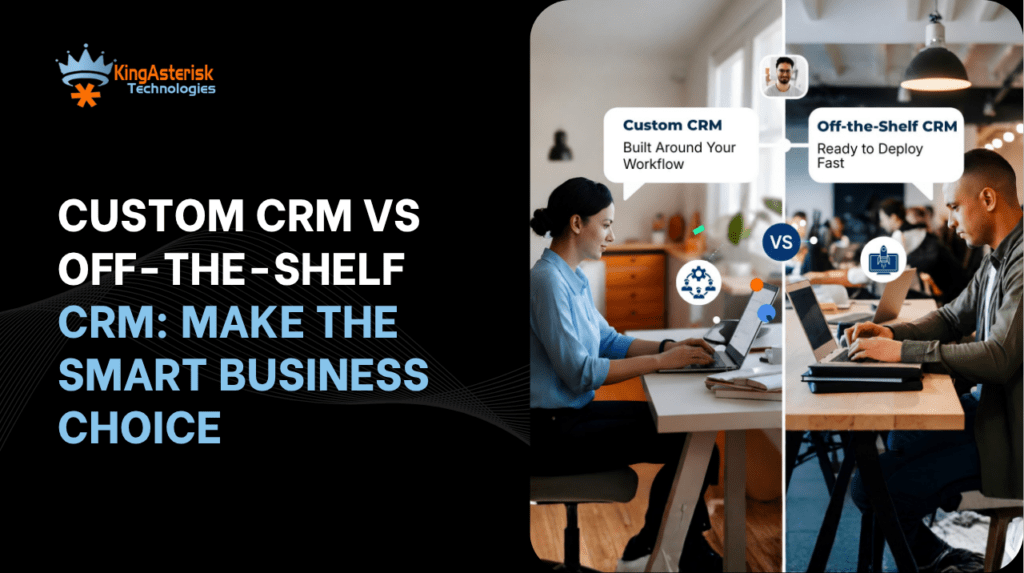
Choosing between custom CRM vs off-the-shelf CRM is one of the most consequential technology decisions a contact center operation will make, and it rarely comes down to price alone. This CRM Integration guide gives you a structured, experience-backed framework to evaluate both paths across total cost, integration depth, workflow fit, and long-term scalability.
By the end, you will know exactly which approach maps to your operational reality.
What Is a Custom CRM?
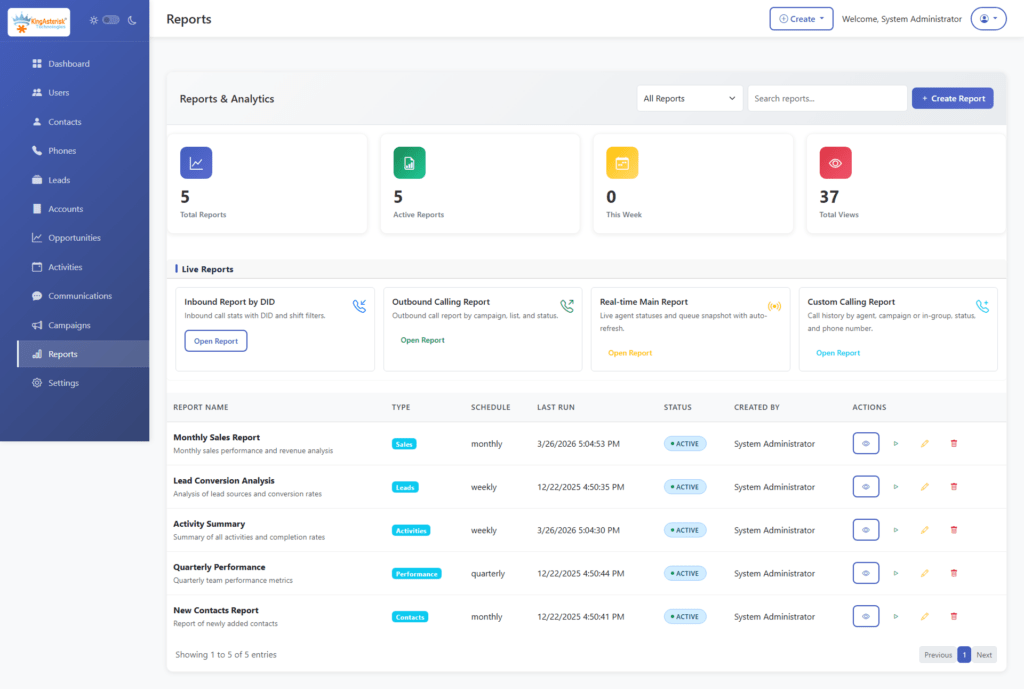
A custom CRM is software engineered from the ground up, or through deep configuration of an open-source base, to match your precise business processes. Every data model, every workflow trigger, every reporting view is built to reflect how your operation actually works, not how a vendor thinks it should work. For contact centers running on Asterisk or VICIdial infrastructure, this often means native event-level integration: automatic ticket creation on answered calls, real-time disposition sync, and screen-pop driven by queue data rather than a polling API.
What Is an Off-the-Shelf CRM?
An off-the-shelf CRM, sometimes called a packaged or commercial CRM, is a ready-made platform designed for a wide range of businesses. Vendors invest heavily in making these products usable across industries, which means they include a broad feature set but are necessarily built around generalised assumptions. Popular examples include Salesforce, Zoho CRM, and HubSpot. Deployment is fast, documentation is mature, and in-house expertise is easier to hire. The trade-off is that you adapt your workflows to the platform’s model rather than the reverse.
Comparison Table
| Criteria | Custom CRM | Off-the-Shelf CRM |
|---|---|---|
| Initial Cost | High (development + setup) | Low to moderate (subscription or licence) |
| Deployment Time | 3–12 months | Days to weeks |
| Workflow Fit | Exact fit to your processes | Adapted to vendor’s model |
| Telephony Integration | Deep, native (Asterisk/VICIdial) | API-based, variable depth |
| Scalability | Built to your growth path | Vendor-dependent feature roadmap |
| Long-term TCO | Lower after 3–5 years | Ongoing per-seat fees accumulate |
| Data Ownership | Full ownership | Shared/vendor-controlled |
| Customisation Ceiling | None | Limited by platform |
The True Cost of Ownership Over Time
Purchase price is the wrong measure. What you actually need to compare is total cost of ownership (TCO) across a three-to-five-year window.
Off-the-Shelf TCO Realities
A typical packaged CRM starts with a manageable per-seat monthly fee. Add 50 agents and the math changes quickly. Overlay premium API access, advanced analytics modules, storage overages, and annual licence increases of 8–15%, and the cumulative spend over five years often surprises buyers who are anchored on the introductory price.
Customisation costs are the less-visible driver. Every time your business process does not match the platform’s model, your team builds a workaround – manual steps, spreadsheet bridges, or bespoke scripts. These workarounds are not free. They consume agent time every day and create fragility that multiplies during staff turnover.
Custom CRM TCO Realities
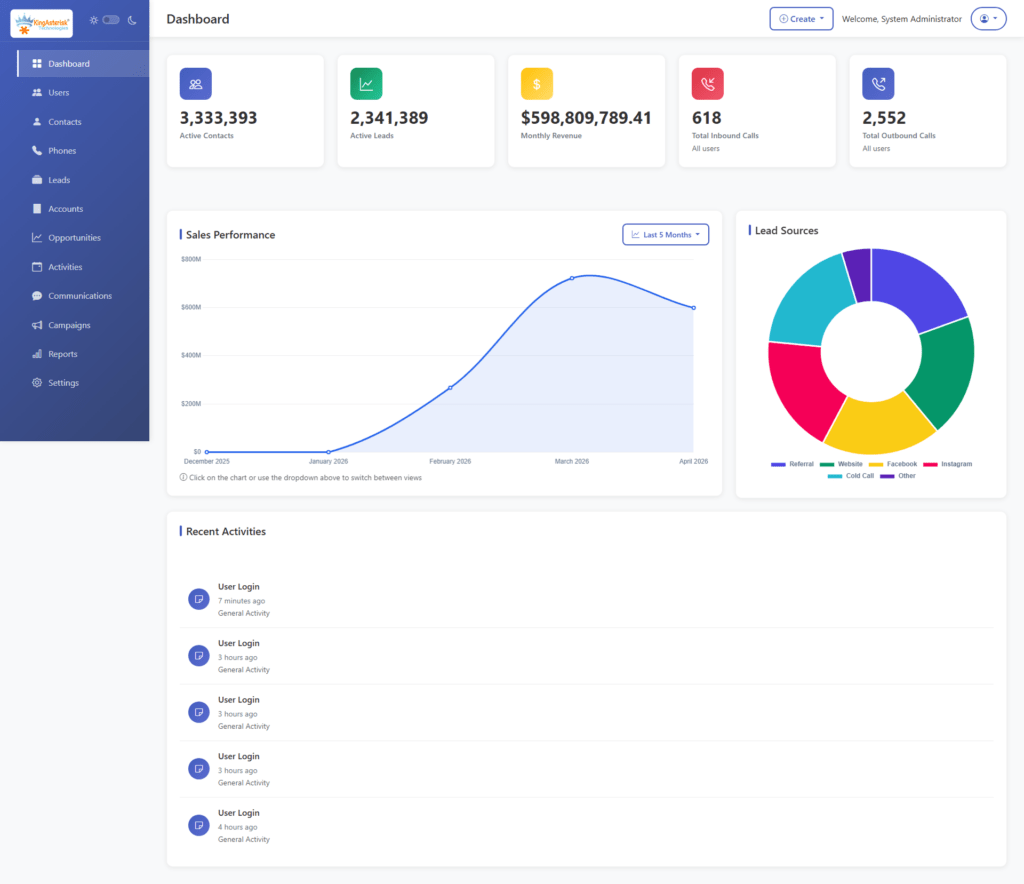
A custom build has a genuine upfront cost: scoping, development, testing, and training. For a well-specified mid-market contact center project, expect four to twelve months of delivery time and a corresponding investment. The economics shift after go-live. There are no per-seat licence fees. New features add to a codebase your team owns. Integrations are deep by design rather than bolted on after the fact.
Maintenance is the ongoing variable. Retaining a competent development partner or an in-house developer is non-negotiable. Factor this in honestly. A custom system with no maintenance plan is a liability, not an asset.
Integration with Telephony Systems: Where It Gets Decisive
For contact centers, CRM value is inseparable from telephony integration. The two systems exchange data on every interaction – call answered, disposition selected, ticket updated, follow-up scheduled. The quality of that exchange directly affects agent efficiency and reporting accuracy.
Custom CRM and Asterisk/VICIdial Integration
When your CRM is custom-built with Asterisk or VICIdial in mind, the integration is event-driven and bidirectional at a native level. The dialler can write directly to the CRM database on call events. The CRM can dynamically adjust IVR routing parameters based on customer segment data. Agent screen-pops load before the call connects, not 2–3 seconds after, because the system is not crossing an API boundary.
This matters for contact centers running predictive or progressive dialling campaigns. Disposition data written in near-real-time allows supervisors to act on campaign performance within the same shift rather than next morning.
Off-the-Shelf CRM and Telephony Integration
Packaged CRM platforms do support telephony integrations. Most offer a CTI (Computer Telephony Integration) layer or marketplace connectors for common platforms. Basic features – click-to-dial, call logging, screen-pop, work reliably in these setups. Advanced use cases, however, frequently require custom middleware that effectively becomes a small custom development project in itself. You end up paying integration development costs on top of the platform licence, narrowing the cost advantage.
Real-World Use Case: A Growing Outbound Contact Center
Consider a contact center operation running 80 outbound agents on VICIdial, handling insurance renewal campaigns across three time zones. Their original packaged CRM tracked customer records adequately but could not reflect the campaign-level disposition logic their business rules required. Agents were maintaining parallel spreadsheets to capture outcome codes that the CRM did not support. Supervisors exported data nightly to produce reports that should have been live.
After a scoping exercise, the team chose to build a custom CRM with a native VICIdial event bridge. Campaign dispositions, call outcomes, and callback scheduling were mapped directly from the dialler into the CRM on each interaction. Reporting became real-time. The parallel spreadsheets were eliminated. Agent average handle time dropped measurably in the first quarter because agents were no longer manually logging outcomes after each call.
The custom build took five months to deliver. Within eighteen months, the elimination of the packaged CRM licence, the middleware tool, and the productivity losses from manual processes had recovered the full development cost.
Decision Framework: Which Path Fits Your Operation?
Use the following criteria to guide your decision. There is no universal answer, the right choice is the one that matches your actual constraints.
Strong Signals for a Custom CRM
- Your contact center has workflows that differ substantially from generic sales or support models.
- You run Asterisk, VICIdial, or a proprietary telephony stack and need deep, event-level integration.
- You are at 50+ agents and the per-seat cost of packaged CRM is already significant.
- You have been building workarounds in your current platform for more than six months.
- Data ownership and security architecture are non-negotiable, your data cannot reside in a third-party environment.
Strong Signals for an Off-the-Shelf CRM
- You are a small or early-stage operation that needs a functioning system within weeks.
- Your workflows closely match standard sales pipeline or support ticket models.
- You lack internal technical resources to oversee a development engagement.
- Your telephony needs are met by standard CTI features: click-to-dial and basic call logging.
- You need a proven, vendor-supported platform your team can self-administer.
A hybrid approach is also worth evaluating: deploy a packaged CRM for standard functions while building a lightweight custom layer that handles the telephony-specific data exchange. This trades some elegance for faster time-to-value and is a practical path for operations in transition.
Frequently Asked Questions
Is custom CRM development worth the cost for a mid-sized contact center❓
For a mid-sized contact center handling 500+ daily interactions with unique escalation workflows or deep Asterisk/VICIdial integration, the answer is often yes. The productivity gains from a precise fit – no workarounds, no manual data bridges, compound over time. Most operations recoup the development investment within two to three years through reduced agent handling time and eliminated third-party middleware fees.
How long does it take to deploy a custom CRM❓
Timelines vary with complexity. A focused deployment for a contact center with clearly documented workflows typically takes three to six months from scoping to go-live. Larger builds with multi-site integration and advanced reporting can take nine to twelve months. Off-the-shelf platforms can be live in days, which is a real advantage when speed is the priority.
Can an off-the-shelf CRM integrate with Asterisk or VICIdial❓
Yes, but with limitations. Most mainstream CRM platforms expose APIs that allow basic screen-pop, call logging, and click-to-dial functions with Asterisk or VICIdial. However, advanced features – real-time queue stats, automated disposition writing, or dynamic IVR branching based on CRM data, generally require custom middleware or a purpose-built solution. The deeper the integration requirement, the stronger the case for a custom build.
What hidden costs should I watch for with off-the-shelf CRM❓
Per-seat licence fees scale quickly as headcount grows. Many platforms charge extra for advanced reporting, API call volumes, storage, or premium support tiers. Custom integrations often require a specialist partner, adding implementation cost. Factor in ongoing subscription increases and the cumulative cost of workarounds your team builds when the platform does not match your process. Total cost of ownership over five years is frequently higher than the initial price suggests.
Conclusion: Making the Right CRM Decision for Your Contact Center
The custom CRM vs off-the-shelf CRM decision is not a question of which product is better in the abstract, it is a question of fit. Off-the-shelf platforms deliver real value for operations that align with their design assumptions. Custom solutions are the stronger choice when your workflows, telephony integrations, or data requirements fall outside what packaged software handles gracefully.
What this guide has shown is that the cost story inverts over time, the integration depth gap is material for Asterisk and VICIdial environments, and the decision is fully reversible only if you plan carefully from the start. Whether you are a contact center operator evaluating your first CRM or an IT manager questioning whether your current platform still fits, the framework above gives you the criteria to decide with confidence.
KingAsterisk has deployed CRM integrations alongside Asterisk, VICIdial, and custom IVR solutions for contact centers across multiple industries and geographies. If you would like an expert assessment of which approach fits your specific infrastructure and scale, get in touch with our team. We are happy to walk through your requirements and give you a straight answer.
Contact KingAsterisk to discuss your CRM integration requirements.