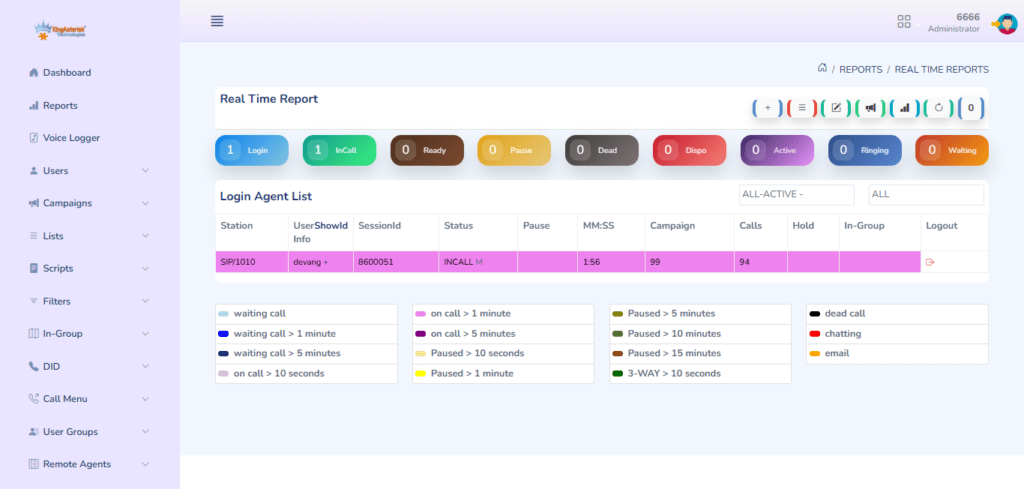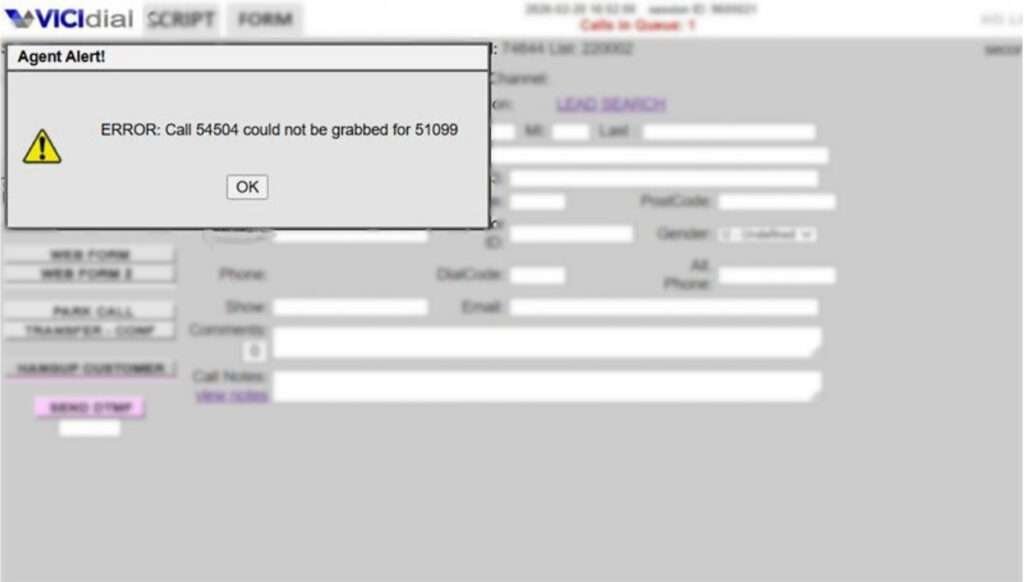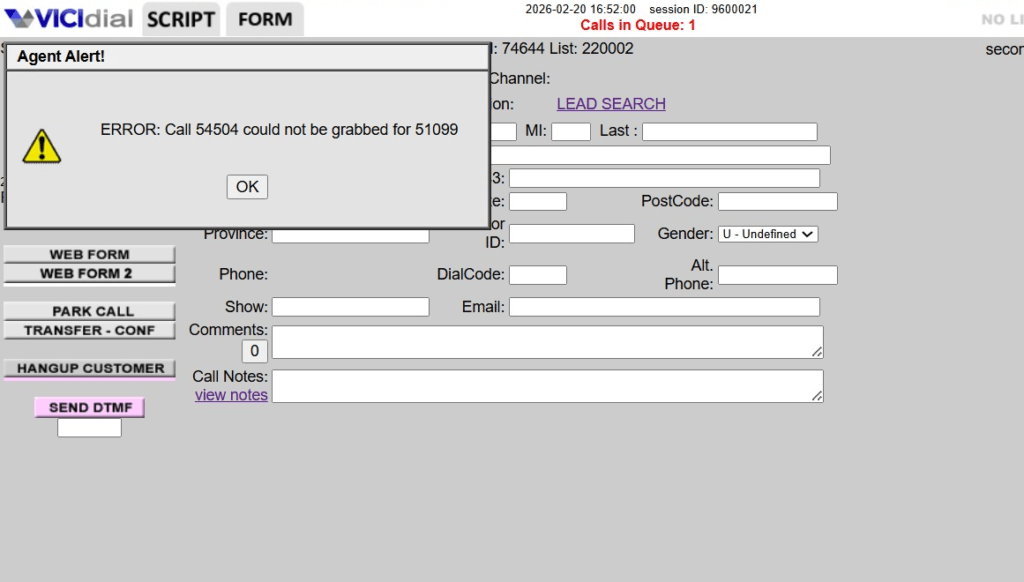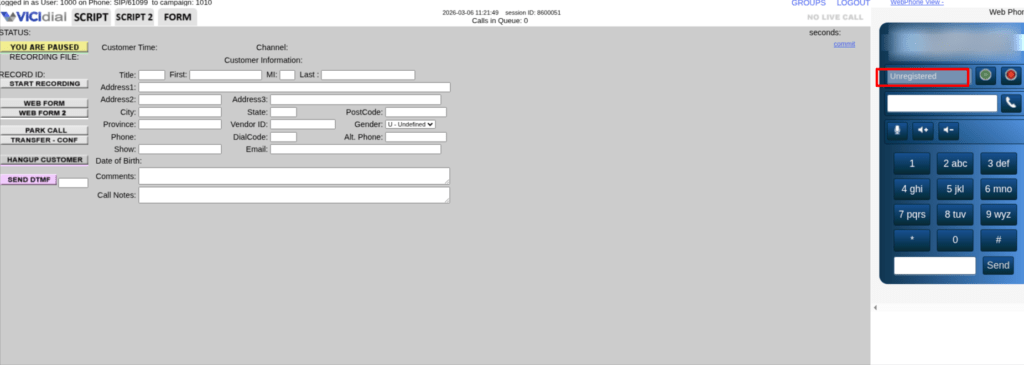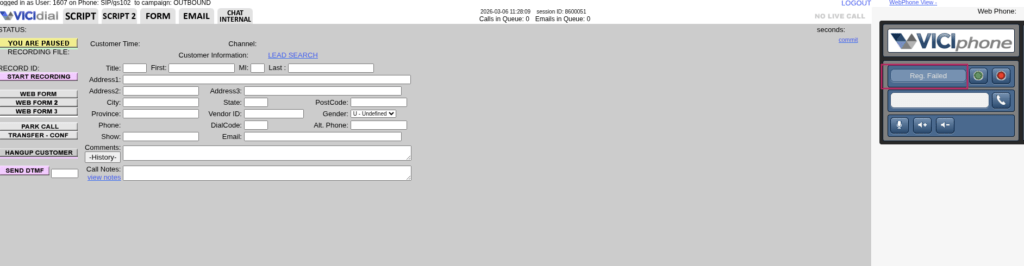

VICIdial firewall blocking agents are one of the most disruptive, and most misdiagnosed, problems a contact center can face. Agents log in, the Vicidial dashboard loads, but calls fail silently: one-way audio, dropped connections, or SIP registration errors that vanish and reappear without warning.
This guide gives you a complete, hands-on resolution path: from accurately diagnosing whether a firewall is the culprit, to whitelisting the right IPs, opening RTP ports 10000–20000, and locking down your VoIP infrastructure so the problem never returns. Whether you are running an on-premise Asterisk server or a cloud-hosted VICIdial instance, every fix here is field-tested.
Why VICIdial Firewall Issues Are More Common Than You Think
VoIP contact centers run on two distinct traffic layers: SIP signaling and RTP media. SIP handles call setup and teardown on port 5060 (or 5061 for TLS). RTP carries the actual audio, and it uses a wide, dynamically negotiated UDP port range, typically 10000 to 20000. Most enterprise firewalls are configured conservatively, blocking UDP traffic by default unless explicitly permitted.
IT teams often open port 5060 correctly but forget the RTP range entirely, leaving agents in a state where calls connect on paper but transmit no audio.
The situation gets worse in mixed environments. A contact center may have a hardware firewall at the office perimeter, software firewalls on each agent workstation, a cloud security group around the VICIdial server, and an ISP-level firewall from the carrier, each capable of silently dropping packets.
Understanding which layer is blocking traffic, and what to open at each one, is the core skill this guide teaches.
How VICIdial Firewall Blocking Agents Actually Works (The Technical Reality)
The SIP Registration Dance
When an agent opens their softphone or browser-based VICIdial agent panel, the first thing that happens is a SIP REGISTER request sent from the agent endpoint to the VICIdial/Asterisk server. If the firewall blocks UDP port 5060, even intermittently, registration fails. The agent sees a status of ‘Not Registered’ or ‘Line Unavailable’ and cannot make or receive calls.
The RTP Audio Problem
Even when SIP registration succeeds, audio requires a separate, bidirectional RTP stream. Once a call is established, Asterisk negotiates an RTP port dynamically from the range 10000–20000. If the firewall has not opened that entire range in both directions, the call connects but one or both parties hear silence. This is the most common complaint from VICIdial administrators: ‘Calls go through but there’s no audio on one side.’
NAT and Firewall State Tables
An additional complication is Network Address Translation (NAT). When agents sit behind a NAT router, which is universal in office and home environments, the return RTP traffic often fails to find its way back because the firewall’s state table entry expires before the call ends, or because the RTP source IP from Asterisk does not match what the firewall is tracking. This is why whitelisting carrier and server IPs is essential, not optional.
nat=force_rport,comedia in your Asterisk SIP peer configuration to help Asterisk handle NAT-traversal automatically. This reduces, but does not eliminate, the need for proper firewall rules.Diagnosing the Problem: Is It Really a Firewall?
Before you start changing firewall rules, confirm the diagnosis. These tests take under five minutes and prevent unnecessary configuration changes.
Quick Diagnostic Checklist
Run this command from an agent machine:
nmap -sU -p 5060 <your-vicidial-server-ip>If the port shows ‘filtered’, the firewall is blocking SIP.
Run this on the VICIdial server during a failed registration attempt:
tcpdump -i any -n udp port 5060If you see the REGISTER packet arrive but no response reaches the agent, the return path is blocked.
Test RTP: initiate a call and run this on the server:
tcpdump -i any udp portrange 10000-20000- No packets = firewall block.
- Packets only in one direction = NAT issue on the agent side.
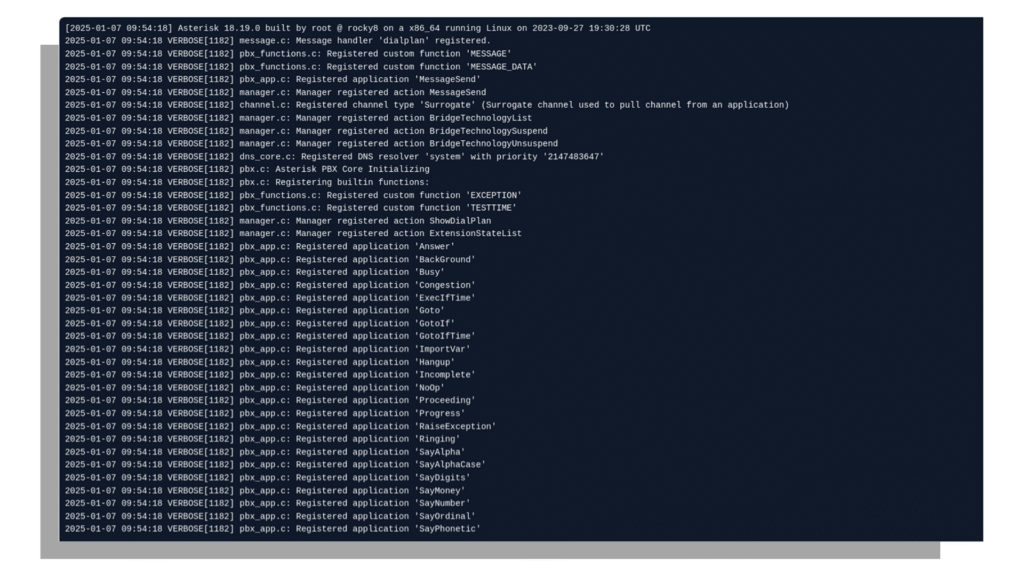
Check Asterisk log: ‘tail -f /var/log/asterisk/full | grep -i rtp’. RTP timeout warnings confirm port blocking.
Temporarily disable the firewall on the server (NOT in production, test environment only) and retry the call. If audio works, the firewall is confirmed as the issue.
WARNING: Never disable your production firewall to test. Use a staging environment or a test agent account to isolate the issue. A VICIdial server exposed to the internet without firewall protection will be compromised within hours.
The Complete Fix: Step-by-Step Resolution
The resolution for VICIdial firewall blocking agents always comes down to three core actions: whitelist office IPs, whitelist carrier IPs, and open RTP ports 10000–20000. Below is the step-by-step implementation for iptables (Linux), followed by notes for cloud environments and hardware firewalls.
Step-by-Step: iptables (Linux — Most Common VICIdial Environment)
1. Identify all relevant IPs and ranges
Your office public IP(s), your VoIP carrier’s IP range (get this from your carrier’s documentation or NOC), and any remote agent IPs or VPN subnet.
2. Allow SIP signaling
Open UDP and TCP port 5060 from carrier and office IPs:
# Allow SIP from carrier IP range
iptables -A INPUT -s <CARRIER_IP_RANGE> -p udp --dport 5060 -j ACCEPT
iptables -A INPUT -s <CARRIER_IP_RANGE> -p tcp --dport 5060 -j ACCEPT
iptables -A INPUT -s <OFFICE_PUBLIC_IP> -p udp --dport 5060 -j ACCEPT
3. Open the full RTP port range
This is the most commonly missed step:
iptables -A INPUT -p udp --dport 10000:20000 -j ACCEPT
iptables -A OUTPUT -p udp --sport 10000:20000 -j ACCEPT
4. Whitelist office IPs
Add a blanket allow for your office subnet to avoid blocking agent web traffic and API calls:
iptables -A INPUT -s 203.0.113.0/24 -j ACCEPT5. Whitelist carrier IPs
Obtain the full list of your carrier’s SIP trunk IP ranges. Example for a generic carrier block:
iptables -A INPUT -s <CARRIER_IP_1> -j ACCEPT6. Allow VICIdial web interface
Agents and supervisors need HTTP/HTTPS access:
iptables -A INPUT -p tcp --dport 80 -j ACCEPT

iptables -A INPUT -p tcp --dport 443 -j ACCEPT
7. Save the rules
Make them persistent across reboots:
service iptables save   # CentOS/RHEL

iptables-save > /etc/iptables/rules.v4   # Debian/Ubuntu
8. Verify — Test a call immediately.
iptables -L -n -v | grep DROPCheck logs to confirm no relevant traffic is still being blocked.
For Web-Based Systems (AWS, GCP, Azure)
In web-based Vicidial deployments, iptables alone are insufficient. You must also update the cloud provider’s Security Group or Firewall Rules:
AWS Security Group
Add inbound rules for UDP 10000–20000 (source: carrier IP range), UDP/TCP 5060 (source: carrier + office IPs), TCP 80/443 (source: 0.0.0.0/0 or restricted subnet).
GCP Firewall Rules
Create a rule with ‘allow udp:10000-20000, udp:5060, tcp:5060’ with target tags pointing to your VICIdial instance.
Azure NSG
Add inbound security rules for the same port ranges with priority above the default ‘DenyAllInBound’ rule.
Real-World Use Case: 50-Seat Contact Center in Chicago
A mid-sized outbound contact center operating a predictive dialer with 50 agents across two floors reported a recurring issue: roughly 30% of outbound calls connected with no audio on either side, while the other 70% worked perfectly. The problem had persisted for three weeks despite multiple Asterisk configuration reviews.
The root cause, identified during a KingAsterisk diagnostic session, was a hardware firewall appliance that had been replaced as part of a routine network refresh. The new firewall’s default policy was stateful UDP tracking with a 30-second idle timeout, far shorter than most VoIP calls. RTP streams that paused briefly (hold music, agent typing pauses) caused the firewall’s state entry to expire, dropping the audio mid-call.
Resolution required three changes:
- The IT team whitelisted the office subnet and all carrier IP ranges, eliminating stateful inspection overhead for trusted VoIP sources.
- RTP ports 10000–20000 were explicitly opened as stateless UDP pass-through rules for those whitelisted IPs.
- The UDP state timeout was increased from 30 to 300 seconds for VoIP traffic flows.
Within two hours of applying the changes, call audio success rate reached 99.7%. Agent productivity, previously impacted by repeat-call attempts and customer complaints, normalized within one business day. This is a textbook example of why VICIdial firewall troubleshooting must always address both IP whitelisting and the full RTP port range simultaneously.
Advanced Configuration: Remote and Work-From-Home Agents
Remote agents introduce a fundamentally different firewall challenge. Unlike office agents who sit behind a single, controllable perimeter firewall, remote agents connect through home routers, residential ISPs, and personal software firewalls, none of which the contact center IT team controls.
Option A: VPN Tunnel (Recommended for High-Security Environments)
Deploy an OpenVPN or WireGuard VPN server. All agent traffic: SIP, RTP, and web, routes through the VPN, which means your server-side firewall only needs to whitelist the VPN subnet. This gives you full control and eliminates ISP-level VoIP blocking.
- Firewall rule: whitelist VPN subnet (e.g. 10.8.0.0/24) for all ports including RTP 10000–20000.
- Agent side: install VPN client, connect before launching VICIdial panel.
- Downside: adds 10–30ms latency depending on VPN server location.
Option B: Session Border Controller (SBC)
An SBC acts as a media relay and firewall traversal proxy between agents and your Asterisk server. It handles NAT traversal, re-encapsulates RTP, and presents a single, stable IP to your firewall. This is the enterprise solution for large VICIdial deployments with geographically distributed agents.
- Firewall rule: whitelist only the SBC’s IP, it handles all agent connections.
- Benefit: eliminates agent-side firewall complexity entirely.
- Best for: 20+ remote agents, multiple time zones, international operations.
Option C: WebRTC Agent Interface
VICIdial supports WebRTC-based agent interfaces that use HTTPS (port 443) and TURN/STUN servers for media traversal. Since port 443 is almost never blocked, this eliminates most firewall issues for remote agents entirely. The tradeoff is slightly higher CPU usage on the server and the need for a properly configured TURN server.
Frequently Asked Questions
Which ports does VICIdial need to open on my firewall❓
At minimum: UDP/TCP 5060 for SIP signaling, UDP 10000–20000 for RTP audio, and TCP 80/443 for the web interface. If using secure SIP, also open TCP 5061. Keep port 3306 (MySQL) blocked from external access entirely — it is internal-only and a common attack vector.
How do I whitelist my VoIP carrier’s IPs in iptables❓
Obtain the full IP range from your carrier’s documentation or NOC team, then run: ‘iptables -A INPUT -s <CARRIER_IP_RANGE> -j ACCEPT’ for each block. Save rules with ‘service iptables save’ (CentOS) or ‘iptables-save > /etc/iptables/rules.v4’ (Ubuntu). Always test with a live call immediately after applying.
Can a cloud security group block VICIdial agents even with iptables open❓
Yes, absolutely. Cloud security groups operate at the hypervisor/network level, before traffic even reaches your VM’s iptables. You must configure both layers independently. A common mistake is correctly setting iptables but leaving the cloud security group at its default deny-all policy. Both must permit SIP and RTP traffic.
What is the fastest way to confirm a firewall is blocking VICIdial❓
Run ‘tcpdump -i any udp port 5060’ on the server during a failed agent registration. If you see the REGISTER packet arrive but no 200 OK returns to the agent, the firewall’s return path is blocked. For audio issues, run ‘tcpdump -i any udp portrange 10000-20000’ during a live call, zero packets confirms RTP is being blocked.
Conclusion
VICIdial firewall blocking agents is a solvable problem, but only when addressed systematically. The pattern is always the same: SIP port 5060 is often partially open, but the RTP range 10000–20000 is either missing or restricted in one direction. Combine that with missing IP whitelists for your office and carrier, and you have a recipe for intermittent audio failures that are frustrating to diagnose and costly in agent productivity.
The three-action resolution, whitelist office IPs, whitelist carrier IPs, open RTP ports 10000–20000, must be applied consistently at every firewall layer in your stack: iptables, cloud security groups, hardware firewalls, and any ISP-level policies. Remote agents add a fourth layer (home routers and residential ISPs) that is best addressed with a VPN or SBC.
At KingAsterisk, we have deployed and maintained VICIdial environments for 900+ contact centers across 2,000+ projects over 14+ years. Firewall misconfiguration is consistently in the top three causes of support tickets, and it is consistently the fastest to resolve once properly diagnosed.
If your agents are still experiencing call issues after following this guide, our team can perform a remote diagnostic and get your VICIdial solution running at full performance.
Still having issues? Get expert help from KingAsterisk.
Try our live demo at demo.kingasterisk.com or contact our team for a free diagnostic session. Contact KingAsterisk